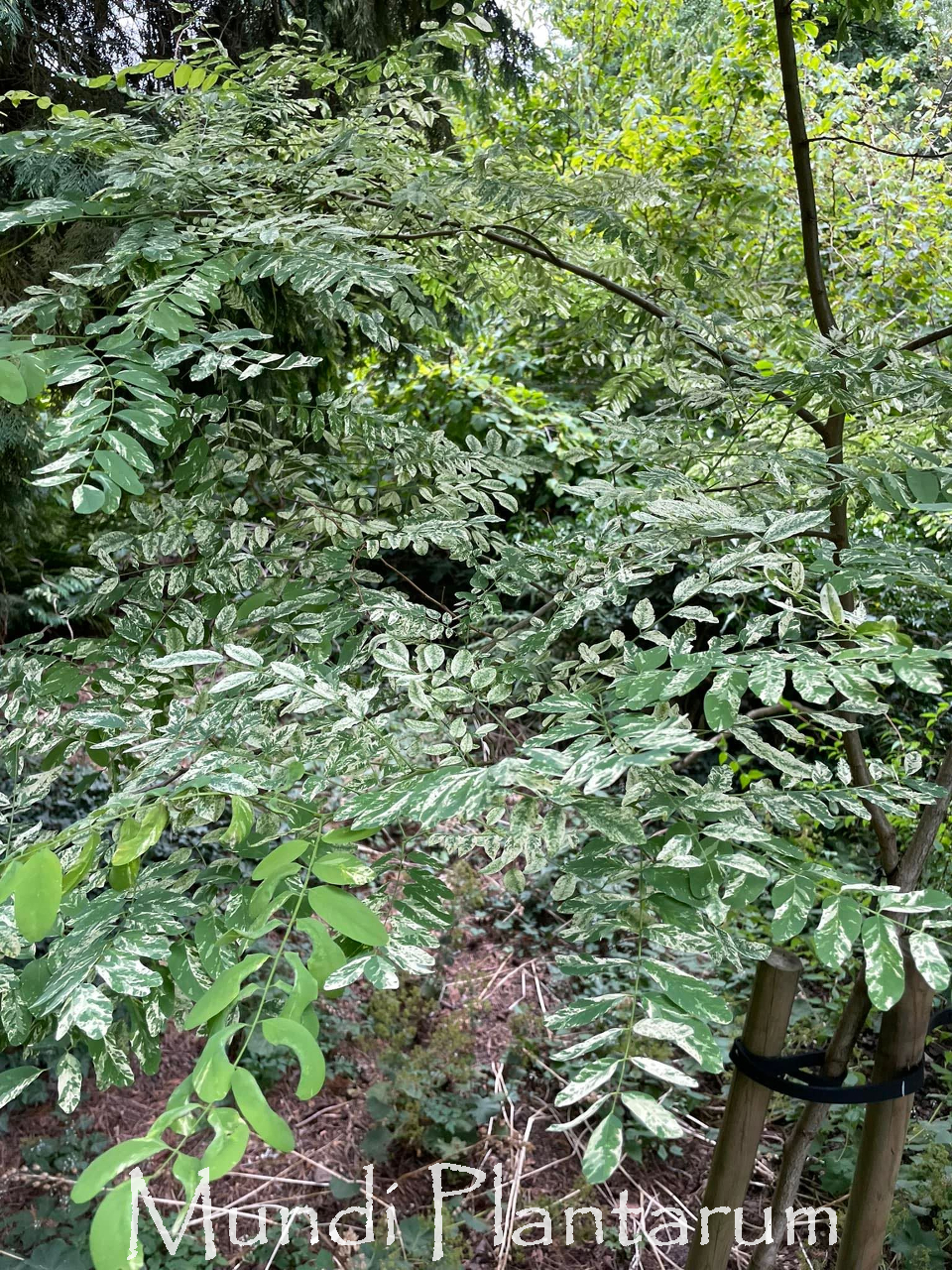
Variegated foliage, green marbled with yellow and light green.
Robinia pseudoacacia ‘Karolina Zamoyska’
Famille:
Fabaceae
Abraham Rammelo
Classification
Trees and shrubsClimate
Zone 6: from -23°C to -17°CLeaf color
- White
- Yellow
- Variegated
- Green
Flower color
- White
- Cream
Size
5 to 10m
Ornamental interest
- Foliage
- Melliferous
Notable plant
- In spring
- In summer
Garden use
- Isolated
GENERAL DESCRIPTION
- ORIGIN: An old Polish variety of black locust, lost for many years, from the famous nurseries of Podzamcze.
- CLIMATE: Withstands -20°C.
- EXPOSURE: Requires a sunny location. Avoid a location too exposed to the wind.
- SOIL: Grows best in deep, fertile soils with an alkaline reaction, but it does well in almost any conditions.
- GROWTH :
- PATHOLOGY:
- MULTIPLICATION:
- PRUNING:
- USE: Recommended for large family gardens, parks, and green spaces. It can also be planted in town squares and plazas. It looks best when planted alone against a dark background. Can be used in landscape compositions with other species.
- MERIT:
- NOTE: This black locust has an amazing and moving history; it is a rare and precious tree. An old Polish variety from the Podzamcze nurseries at the beginning of the 20th century, it then disappeared without a trace, until in 1981, a variegated specimen was discovered near Warsaw and identified as the Karolina Zamoyska variety.
GENERAL PHYSIOLOGY
- DIMENSIONS: Can reach 8 to 10m.
- PORT: Soft and breathable port.
- TRUNK:
- BARK:
- BRANCHES :
- NOTE:
PHYSIOLOGY OF LEAVES
- FORME:
- COLOR: A variety of leaves, marbled with white and yellow.
- NOTE:
PHYSIOLOGY OF FLOWERS
- TIME: May-June.
- FORM:
- COLOUR: Creamy white.
- NOTE: Very fragrant.
PHYSIOLOGY OF FRUIT
- FORM:
- COLOUR: Reddish-brown.
- SEEDS :
- NOTE :